
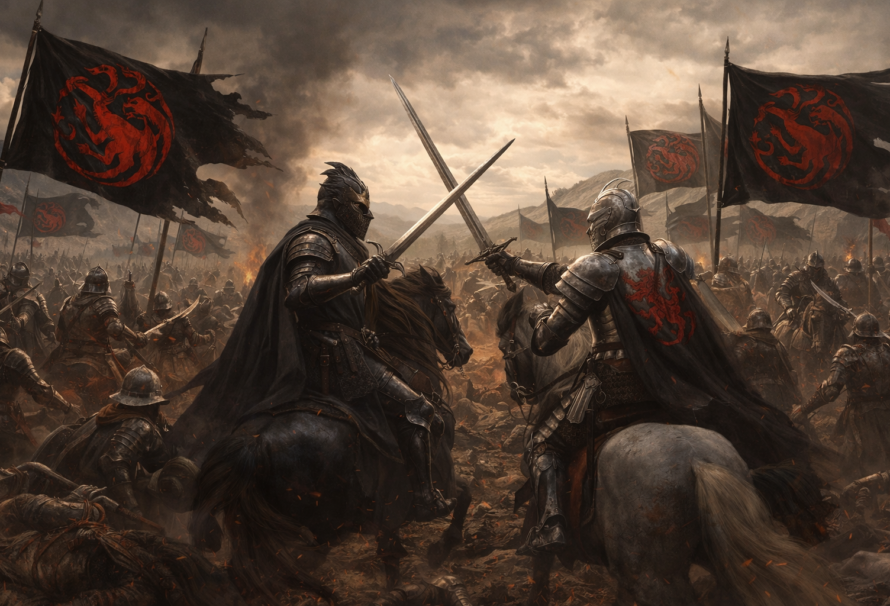
Long before the events of Game of Thrones or House of the Dragon, another brutal conflict nearly tore the Seven Kingdoms apart. Known as the Blackfyre Rebellion, this civil war between rival branches of House Targaryen left scars that would echo through Westerosi history for generations.
The rebellion is especially important for fans of George R. R. Martin’s Dunk and Egg stories, which form the basis of HBO’s upcoming series A Knight of the Seven Kingdoms. Many characters in the series lived through the aftermath of this war, and its political consequences still shape the world that Ser Duncan the Tall and Egg travel through.
Understanding the Blackfyre Rebellion helps explain the tensions, loyalties, and grudges that linger throughout this era of Westeros.
The Origin of the Blackfyre Claim
The roots of the rebellion go back to King Aegon IV Targaryen, often remembered as Aegon the Unworthy. His reign was marked by corruption, scandal, and a long list of acknowledged bastards.
One of those bastards was Daemon Waters, the king’s son with Princess Daena Targaryen. Daemon grew into a legendary warrior and quickly became admired throughout the realm.
Shortly before his death, Aegon IV made a decision that would have devastating consequences. He legitimized all of his bastards, including Daemon Waters.
More importantly, he gifted Daemon the legendary Targaryen sword Blackfyre, a weapon traditionally carried by the kings of Westeros. Many interpreted this act as a signal that Aegon believed Daemon deserved the throne more than his lawful heir.
Daemon soon took the name Daemon Blackfyre, founding a rival branch of House Targaryen.
Daeron II and the Growing Tension
After Aegon IV died, the Iron Throne passed to his legitimate son King Daeron II Targaryen.
Daeron was a very different ruler from his father. Rather than pursuing conquest, he focused on diplomacy and stability. His greatest achievement was peacefully bringing Dorne into the Seven Kingdoms, something earlier Targaryen kings had failed to accomplish through war.
However, this diplomatic approach angered many lords who preferred the old warrior culture of Westeros.
These dissatisfied nobles began rallying around Daemon Blackfyre, seeing him as the stronger and more traditional ruler. Rumors also circulated that Daeron might not have been Aegon IV’s true son, further fueling the political divide.
The First Blackfyre Rebellion
Eventually the tensions erupted into open war.
In 196 AC, Daemon Blackfyre declared himself the rightful king of Westeros and raised his banner against Daeron II. Many powerful houses joined him, including several prominent warriors who believed Daemon would make a stronger ruler.
The conflict quickly became one of the most devastating civil wars since the Dance of the Dragons.
The war reached its decisive moment during the Battle of the Redgrass Field, one of the most famous battles in Westerosi history.
There, Daemon Blackfyre faced the forces of the crown led by Daeron’s loyal supporters.
The battle ended when Brynden Rivers, also known as Bloodraven, used his archers to kill Daemon Blackfyre and two of his sons on the battlefield. Without their leader, the rebellion collapsed.
The Blackfyre Line Continues
Although Daemon Blackfyre died, the conflict did not truly end.
Several of his surviving sons fled across the Narrow Sea and continued to claim the throne of Westeros. Over the next decades, multiple Blackfyre Rebellions would erupt as the exiled family repeatedly attempted to reclaim the Iron Throne.
These conflicts kept the realm unstable for generations and created lasting divisions among the noble houses. Even decades later, loyalties to the Blackfyre cause still lingered.
Why the Blackfyre Rebellion Matters in A Knight of the Seven Kingdoms
By the time Dunk and Egg begin their adventures, the First Blackfyre Rebellion has already ended, but its consequences remain everywhere.
Many older characters in the stories fought in the war and still carry strong opinions about the conflict. Some were loyal to King Daeron II, while others secretly supported Daemon Blackfyre.
One example is Ser Eustace Osgrey, a knight who served the Blackfyre cause during the rebellion and still speaks proudly of Daemon decades later.
This lingering division adds a layer of political tension to the otherwise small scale stories of wandering knights and rural disputes. The war may be over, but its emotional and political impact continues to shape the realm.
A Conflict That Shaped Westeros
The Blackfyre Rebellion represents one of the most important turning points in Westerosi history. It was more than just a fight over the throne. The war divided noble houses, created long lasting rivalries, and weakened the unity of the Seven Kingdoms.
By the time of A Knight of the Seven Kingdoms, the realm is technically at peace, but the memory of the rebellion still lingers in conversations, loyalties, and political suspicions.
For Dunk and Egg, traveling through Westeros means encountering people who still remember the war very differently depending on which side they fought for. That legacy ensures the story of the Blackfyre Rebellion remains one of the most important chapters in the history of Westeros.